
Press Releases
- Details
- Category: Press Releases
 SPRINGFIELD – State Senator Bill Cunningham has introduced a measure that would create groups tasked with retrieving Firearm Owner Identification (FOID) cards after they have been revoked.
Although state law already allows the state to revoke FOID cards if an individual is deemed unfit to carry a firearm, there is no system currently in place to ensure that a FOID is physically revoked to prevent further gun purchases. Senate Bill 715 would create firearm Revocation Enforcement Groups charged with recovering FOID cards that have been revoked by the state of Illinois.
The bill is an initiative of Cook County Sheriff Tom Dart.
Circumstances under which the state has the authority to revoke a FOID card from an individual include instances when a card holder commits a felony, becomes addicted to narcotics, has committed acts of domestic violence or is diagnosed with a mental condition that presents a clear and present danger to oneself or others.
“If an individual has been found unfit to possess a firearm due to criminal activity or mental illness, there needs to be a process by which his or her FOID card is physically revoked,” said Cunningham, a Democrat who represents portions of Chicago and the southwest suburbs. “This is a common sense law that will make Illinois safer.”
Cunningham introduced the bill in response to the February 15 mass shooting in Aurora that killed five people and injured several others, including five police officers.
“The Aurora shooter was a felon with a long history of violent behavior, and yet he was still allowed to retain his FOID card and purchase a gun,” Cunningham said. “This is a clear and persistent problem around our country and we need to act now to prevent a tragedy like this from happening again.”
- Details
- Category: Press Releases
 SPRINGFIELD – State Senator Bill Cunningham voted Thursday for legislation that would increase the age to legally purchase tobacco products in Illinois to 21.
“The tobacco industry’s long history of targeting young people has shown that they’re willing to sacrifice teenagers’ health to line their own pockets,” said Cunningham, a Democrat who represents portions of Chicago and the southwest suburbs. “This is a public health issue and I’m proud to support a bill that protects Illinois teenagers by helping prevent what could become a lifelong addiction.”
House Bill 345 would make Illinois the seventh state in the country to raise the tobacco purchasing age to 21. More than 300 municipalities across the United States have adopted Tobacco 21, including 24 communities in Illinois.
Raising the tobacco purchasing age has been proven to reduce the number of high school students who use tobacco products. In Chicago, where Tobacco 21 is currently in effect, the high school smoking rate dropped from 13.6 percent in 2011 to 6 percent in 2017.
The measure passed the Senate 39-16. It will now go to the governor’s desk.
- Details
- Category: Press Releases
 SPRINGFIELD – State Senator Bill Cunningham met with local students on Tuesday to have a conversation about technical education and professional development in Illinois.
Students from Community High School District 218 in Oak Lawn came to Springfield for the Illinois Association of Career and Technical Education’s Showcase Day, on which students from around the state demonstrate their skills and respond to education and workforce issues in Illinois.
“It’s inspiring to see so many students taking an interest in technical education and being engaged in the related issues that come before the Illinois State Senate,” said Cunningham, a Democrat who represents portions of Chicago and the southwest suburbs.
“I have long been an advocate for providing our students with ample opportunities no matter what type of education they wish to pursue and look forward to continuing to promote career and technical education in Springfield.”
Senator Cunningham represents portions of Worth, Orland and Palos Townships in the southwest suburbs and the neighborhoods of Mt. Greenwood, Beverly, Morgan Park and Auburn-Gresham in Chicago.
- Details
- Category: Press Releases
 Chicago – Every year, hundreds of properties in Cook County are lost by homeowners to so-called "tax scavengers," who buy houses at auction when the owner fails to pay property taxes. Oftentimes, homeowners are caught off guard, having missed their property tax bill in the mail or because they failed to keep up with confusing paperwork.
“Property owners can find themselves in crisis situations because they’re unaware their property taxes went unpaid,” said State Senator Bill Cunningham, a Democrat who represents portions of Chicago and the southwest suburbs. “Senior citizens are more likely to face this issue because their mortgages are more likely to be paid off, so a bank is no longer ensuring the taxes are being paid through an escrow account."
In Senator Cunningham’s district alone, there are 1,530 property owners who are past due on their property taxes, according to records maintained by the Cook County Treasurer’s Office. Of those, 84 are senior citizens.
“Cook County residents who don’t know their status should check with the Cook County Treasurer’s Office,” said Cunningham. “This is an easy problem to avoid with a quick phone call or by spending some time on the treasurer's website.”
The County Treasurer can be reached at 312-443-5100 or at cookcountytreasurer.com. To check your property's tax payment status enter your Property Index Number (PIN) or property address here.
Senator Cunningham represents portions of Worth, Orland and Palos Townships in the southwest suburbs and the neighborhoods of Mt. Greenwood, Beverly, Morgan Park and Auburn-Gresham in Chicago.
- Details
- Category: Press Releases
 SPRINGFIELD – A measure sponsored by State Senator Bill Cunningham to combat opioid overdoses by improving emergency response time passed the State Senate in a bipartisan vote Wednesday.
“We’re facing a crisis when it comes to overdoses in our state and we need to empower our first responders to act quickly,” said Cunningham, a Democrat who represents portions of Chicago and the southwest suburbs. “It’s time for lawmakers to get aggressive in the fight against opioid abuse.”
Senate Bill 1258 would require emergency medical technicians in Chicago to report treatment of an individual experiencing a suspected or actual opioid overdose to the city for use in the Overdose Detection Mapping Application (ODMAP), developed by the Washington/Baltimore High Intensity Drug Trafficking Area (HIDTA).
The ODMAP provides real-time overdose data throughout an area to mobilize an immediate response to an overdose spike. Each suspected overdose is plotted to a map that allows local officials to identify trends and develop strategies to more effectively respond to overdoses.
“This program will be an effective tool as we try to prevent overdose deaths,” Cunningham said. “I encourage my colleagues in the House to pass this measure quickly to provide desperately needed help for the people of Chicago.”
Senate Bill 1258 passed 54-0. It will now go before the House of Representatives.
- Details
- Category: Press Releases
 SPRINGFIELD –State Senator Bill Cunningham has introduced a bill this legislative session that would seek to solve residential noise and air quality issues by prohibiting diesel trucks from idling excessively in residential areas.
Senate Bill 1256 would prevent diesel trucks from idling for more than a total of ten minutes in an hour if the vehicle is within 200 feet of a residential area.
Cunningham credited Cook County residents living near a trucking yard in Merrionette Park for bringing the issue to his attention. The residents identified persistent noise and air quality issues with the trucking yard that needed to be addressed.
“Illinois residents should not have to deal with excessive noise and poor air quality at their own homes,” said Cunningham, a Democrat who represents portions of Chicago and the southwest suburbs. “This bill is intended to finally bring some peace and quiet to families that live near these commercial trucking yards.”
Senate Bill 1256 is currently in the Senate Environment and Conservation Committee.
- Details
- Category: Press Releases
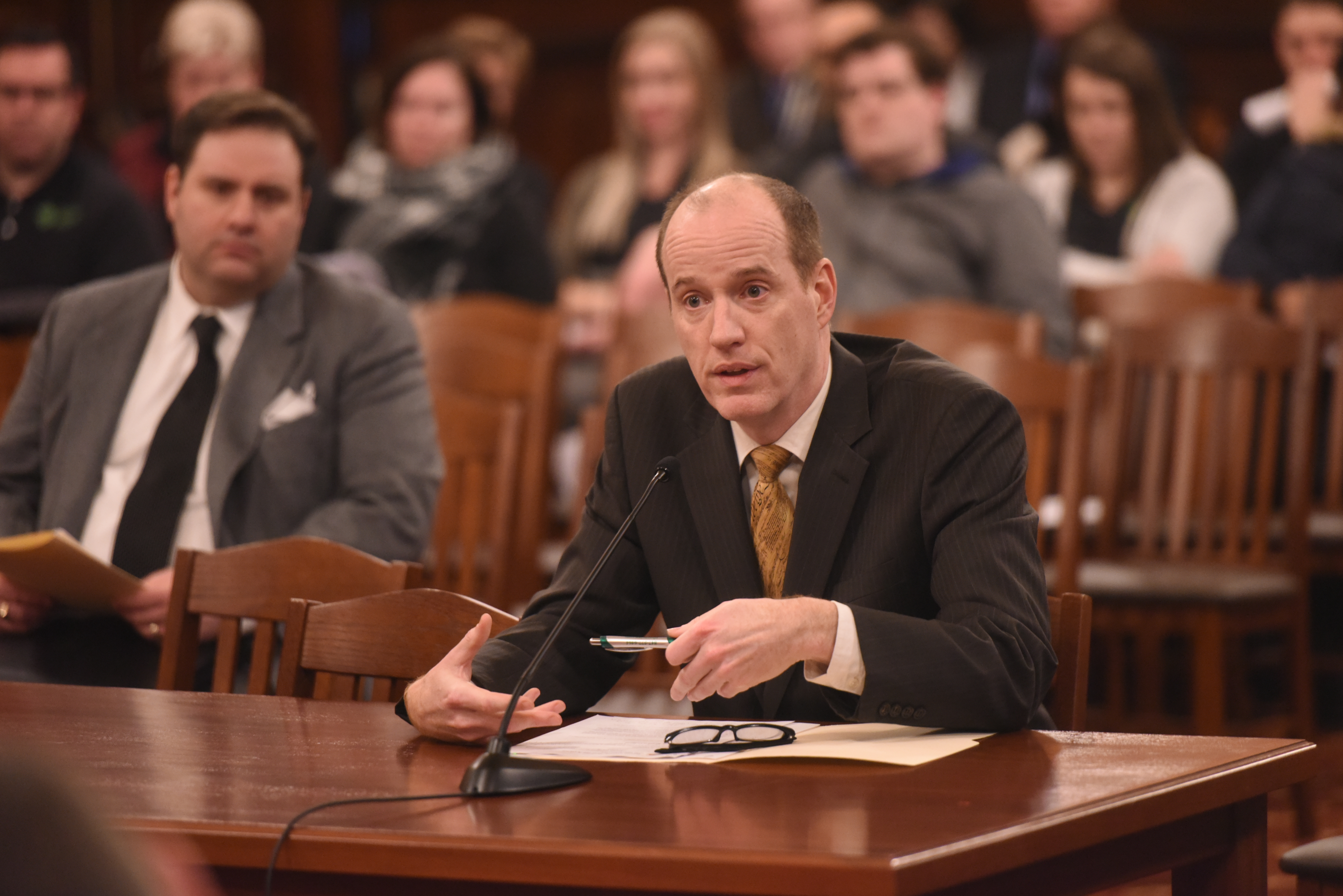 SPRINGFIELD – A measure sponsored by State Senator Bill Cunningham that would make it easier for seniors to receive a tax break passed the Senate Revenue Committee in a bipartisan vote Wednesday.
Senate Bill 1257 would eliminate the need for Cook County residents aged 65 or older to reapply annually to receive the Senior Citizen Homestead Exemption, a property tax exemption designed to assist senior citizens financially.
Currently, every county in Illinois other than Cook may allow seniors to receive the exemption without reapplying.
“The requirement to reapply annually for this tax break places an undue burden on our senior citizens,” said Cunningham, a Democrat who represents portions of Chicago and the southwest suburbs. “Eliminating this requirement will not only assist our seniors by streamlining the process, but also eliminate an unnecessary use of resources that could be directed elsewhere.”
The measure also requires the Cook County Accessor’s Office and the Recorder of Deeds Office to communicate when a home receiving an exemption is sold to ensure the tax break is not awarded to residents who do not qualify.
Senate Bill 1257 will now go before the entire Senate.
- Details
- Category: Press Releases
 SPRINGFIELD – State Senator Bill Cunningham voted Thursday to increase Illinois’ minimum wage to $15, saying the legislation will make great strides toward easing the financial burden on working class families.
“Working mothers and fathers in Illinois should not be forced to work multiple jobs just to provide the bare minimum their families need to get by,” said Cunningham, a Democrat who represents portions of Chicago and the southwest suburbs. “A living wage is not a privilege, but a basic human right and we must ensure every Illinois worker has access to this right.”
Senate Bill 1 would gradually increase the minimum wage in Illinois to $15 an hour by 2025. The first increase will take effect on Jan. 1, 2020 and set the minimum wage at $9.25.
The step-by-step rollout of the increase is designed to allow businesses to adjust to the law and adapt accordingly. The bill also includes a tax credit for small businesses with 50 or fewer employees to help offset the cost of the wage increase.
Illinois’ minimum wage has been $8.25 an hour since 2010. In the city of Chicago, the minimum wage is set to increase to $13 an hour this year.
“This legislation will help bring stability to families who are struggling to make ends meet,” Cunningham said. “Illinois workers have long deserved a raise and I am proud to support the measure that will bring it to them.”
The bill will now go to the House of Representatives.
More Articles …
Page 19 of 37

Follow Sen. Cunningham


eNewsletter Signup
Contact Info
Springfield Office:
Senator 18th District
325-G Capitol Building
Springfield, IL 62706
(217) 782-5145
(217) 782-2115 FAX
District Offices:
10400 S. Western Ave.
Chicago, IL 60643
(773) 445-8128
(773) 672-5143 FAX