
Press Releases
- Details
- Category: Press Releases
CHICAGO – The City of Chicago would be prohibited from requiring police officers to fulfill ticket quotas and assessing officers based on the number of tickets they issue under a plan signed into law today.
Senate Bill 3509, sponsored by State Senator Bill Cunningham, rescinds Chicago’s exemption from a 2014 law banning counties and municipalities from assigning ticket quotas and using the number of tickets an officer issues as a performance evaluation. The law made exemptions for municipalities with their own independent inspectors general and law enforcement review authorities.
“Policing should not be used as a revenue enhancement strategy by municipalities,” said Cunningham, a Democrat representing Chicago and the southwest suburbs. “Officers will no longer be distracted from their regular law enforcement duties in order to meet ticket quotas.”
The Fraternal Order of Police argued that ticket quotas created unnecessary tension between law enforcement and the communities they serve by interfering with officers’ ability to exercise compassion in certain situations.
- Details
- Category: Press Releases
Cunningham: ‘This is the result of Gov. Rauner’s obsessive attacks on public workers’
 CHICAGO – State Senator Bill Cunningham expressed disappointment in this morning’s U.S. Supreme Court decision to weaken collective bargaining rights for average workers who depend on unions to amplify their voice in the workplace.
“This is the result of Gov. Bruce Rauner’s obsessive attacks on teachers, police officers, firefighters and all the other public employees who do difficult work on behalf of taxpayers every day,” said Cunningham, a Democrat representing Chicago and the southwest suburbs.
“The middle class is shrinking in our nation, and it is in large part due to the loss of union jobs. Those losses will accelerate with the Janus decision. It’s both shameful and telling that the governor will count this set-back for working families as one of the few ‘accomplishments’ of his tenure.”
The U.S. Supreme Court’s ruling in the landmark Illinois public employee union case Janus v. AFSCME Council 31 overturns unions’ ability to collect fees from non-members to cover the costs of collective bargaining and enforcement of labor contracts. These fees are known as “fair-share” or “agency fee” payments.
Rauner filed suit over fair-share fees in 2015 shortly after becoming governor. The Supreme Court’s ruling, which overturns a 1977 decision, has implications for collective bargaining units all over the country.
- Details
- Category: Press Releases

CHICAGO – A resolution presented by State Senator Bill Cunningham celebrates the 50th anniversary of the Special Olympics and congratulates Special Olympic athletes, past and present, on their accomplishments.
“As athletes and organizers from all over the world prepare to convene in Chicago to celebrate the Special Olympics’ 50th anniversary, I’m privileged to present Senate Resolution 1796 to commemorate the athletes who have carried this movement for their continuous inspiration over the past 50 years and to encourage the next generation of athletes and volunteers to get involved,” Cunningham said.
While the official 2018 Special Olympic Games will take place in Seattle this summer, there is a week-long series of events taking place in Chicago from July 17-21 to celebrate the Games’ 50th anniversary and raise awareness and support of the Special Olympics and its “Choose to Include” movement. Over 70,000 athletes and supporters are scheduled to attend.
Earlier this year, the Chicago Park District presented the Eternal Flame of Hope Monument as a permanent tribute to the organization and its athletes. The monument sits at the entrance of Soldier Field, the site of the very first Special Olympics.
The Special Olympics was inaugurated in July of 1968 by Eunice Kennedy Shriver, the sister of President John F. Kennedy, who invited 1,000 intellectually disabled athletes from 26 states and Canada to Chicago’s Soldier Field to compete in Olympic-style track and field events.
Cunningham has been an active supporter of the Special Olympics for years, having frequently participated in the organization's Polar Plunge and the Law Enforcement Torch Run for Special Olympics Illinois to raise money and to gain awareness for the athletes who participate in the games.

- Details
- Category: Press Releases

SPRINGFIELD – Illinois residents will no longer have to pay a fee to protect their identity when freezing their credit thanks to legislation that was signed into law today.
House Bill 4095 is an initiative of Attorney General Lisa Madigan and State Senator Bill Cunningham, a Democrat representing Chicago and the Southwest Suburbs.
The new law will bar credit reporting agencies from charging consumers a fee to place or lift a freeze on their credit report, and gives consumers the ability to do so electronically or over the phone instead of by certified mail.
“This law guarantees that consumers will not have to pay a fee to protect their credit after a credit agency jeopardizes their personal information,” Cunningham said. “By updating the law to allow consumers to place or lift a credit freeze electronically or over the phone, the measure ensures consumers are able take action to prevent or minimize damage to their credit.”
This action comes in response to the massive data breach suffered by Equifax from May to July of last year. As many as 143 million Americans nationwide and 5.4 million Illinois residents may have been impacted by the breach of sensitive consumer information.
The legislation takes effect immediately.
- Details
- Category: Press Releases
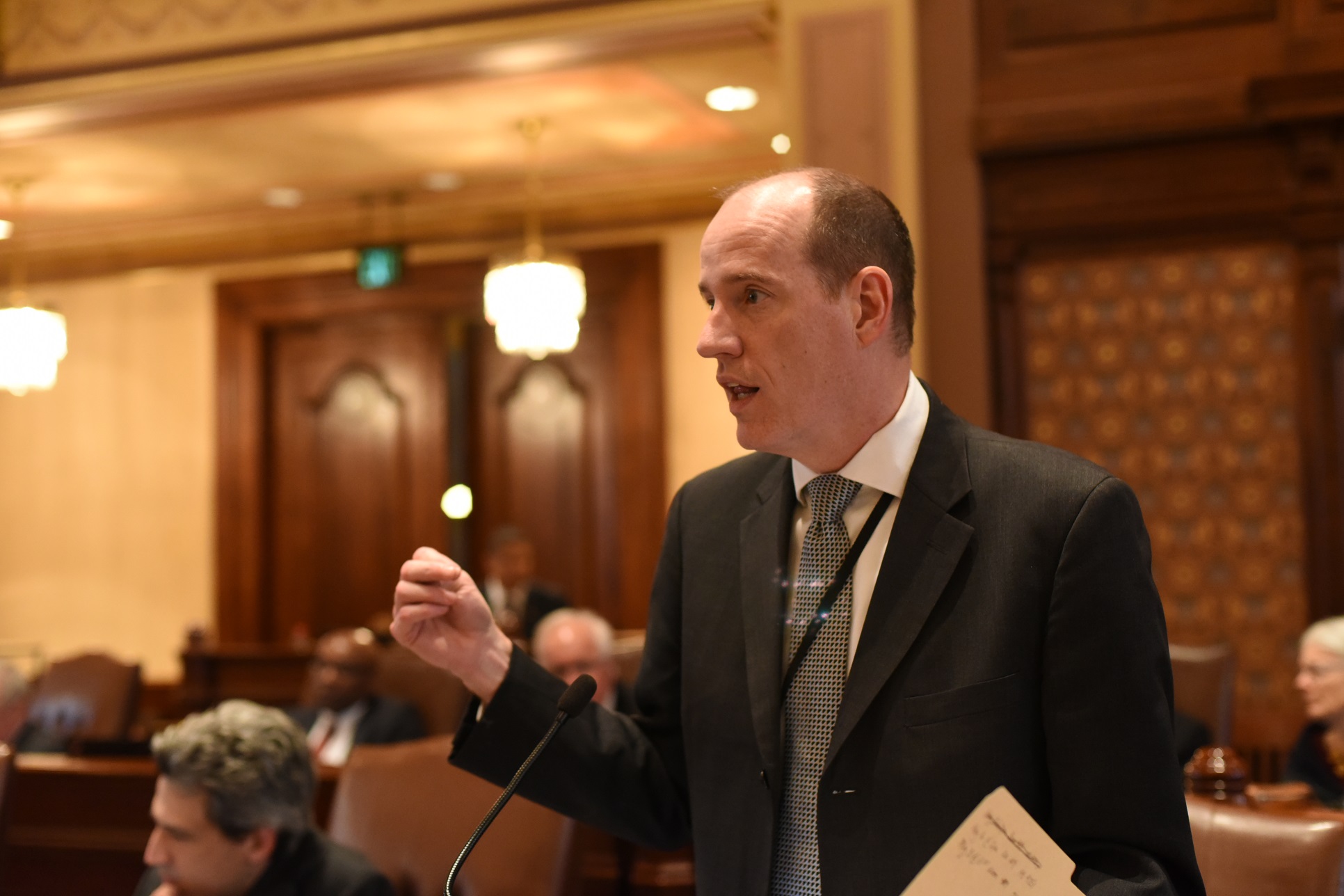
SPRINGFIELD – Legislation passed by the Illinois General Assembly today would eliminate long-term delays Cook County property owners face in obtaining refunds for flawed tax assessments and overpayments.
Senate Bill 1979 aims to provide property owners with the money they are owed in a timelier manner by increasing the yearly limit on the amount of property tax overpayments that may be refunded to $5 million from $2.5 million.
Each year, the current threshold is reached very quickly, which causes a long-term backlog in refunds that property tax owners are entitled to.
SB 1979 is sponsored by State Senator Bill Cunningham and State Representative Fran Hurley, Democrats representing parts of Chicago and the Southwest Suburbs.
“Property owners should not be put on a years-long waiting list to receive money that is rightfully theirs,” Cunningham. “This legislation would alleviate that backlog by doubling the amount of money Cook County is authorized to award each year for overpaid property taxes.”
In 2017, 402 taxpayers did not receive a refund for their overpaid taxes, according to research Kensington Research & Recovery, a firm that assists taxpayers with obtaining refunds.
There is currently an estimated $94.1 million in unclaimed tax overpayments, according to the Cook County Treasurer’s office.
“Cook County’s current system for issuing refunds for overpaid property taxes is simply unsustainable. Based on preliminary data, hundreds of taxpayers are set to go another year without receiving their refunds,” Hurley said. “Senate Bill 1979 will accelerate the process in which the nearly $100 million owed to property owners is recovered.”
Under SB 1979, if payment of a claim for a refund would cause the total amount of taxes and interest for all claims to exceed $5 million for the given year, the refund will be paid in the succeeding year.
SB 1979 awaits the Governor’s signature to become law.
- Details
- Category: Press Releases

SPRINGFIELD – State Senator Bill Cunningham issued the following statement following the passage of a balanced budget plan by the Illinois Senate:
“This bipartisan budget is a responsible spending plan agreed to by leaders from both parties and chambers that rejects the governor’s cost shifts and fulfills our obligation to students and teachers. By increasing K-12 funding by $352 million and fully funding teachers’ retirement and pensions, this budget avoids the governor’s proposal to shift responsibility for paying teacher pensions from the state to local property tax payers.
“The budget provides a 2 percent increase in funding to state universities and makes MAP Grants securable for four years, which will help students plan a foreseeable academic path at schools in Illinois instead of seeking out-of-state schools. The budget also includes a new merit and financial based scholarship program, AIM HIGH, for undergraduate students at public universities geared toward keeping our best and brightest students in Illinois.”
Cunningham is a Democrat representing parts of Chicago and the Southwest Suburbs.
- Details
- Category: Press Releases

SPRINGFIELD – Rank-and-file Chicago firefighters would have greater oversight and control of funding intended for their department under legislation passed by the Illinois Senate today.
Sponsored by State Senator Bill Cunningham and State Representative Fran Hurley, House Bill 5197 would establish a Foreign Fire Insurance Board, an entity that will be entrusted with the expenditure of fire insurance fees collected exclusively from insurance companies whose corporate headquarters are located outside of Illinois.
Currently, the City of Chicago receives about $5 million in fire insurance fees, which are directly deposited into the city’s general fund. HB 5197 would transfer control of those funds to a newly established fire insurance board and require the city to turn over fire insurance revenue to the board.
“The legislation streamlines the flow of tax dollars and allows Chicago firefighters to determine how revenue intended for their own department is used,” said Cunningham, a Democrat representing parts of Chicago and the Southwest Suburbs. “The funding will now go directly to fire suppression instead of being spread throughout the city budget.”
Advocates of the legislation say it will improve Chicago firefighters' safety and effectiveness through enhancements in their equipment and training. The funds will be used to purchase of items such personal protective gear, tools, fire apparatus, enhanced training and for firehouse improvements.
“This newly created board will draw on the knowledge, experience and expertise of the rank-and-file to purchase items that allow them to safely operate in the many hazardous situations they routinely encounter,” said Robert Tebbens, director of political action for the Chicago Firefighters’ Union. “It will also give their families confidence that they will return home safely.”
Under current law, the Chicago Fire Department is the only one in the state that does not have a fire insurance board. The fire insurance board would consist of the department’s fire commissioner and six elected trustees.
HB 5197 now heads to the House for approval.
More Articles …
Page 21 of 37

Follow Sen. Cunningham


eNewsletter Signup
Contact Info
Springfield Office:
Senator 18th District
325-G Capitol Building
Springfield, IL 62706
(217) 782-5145
(217) 782-2115 FAX
District Offices:
10400 S. Western Ave.
Chicago, IL 60643
(773) 445-8128
(773) 672-5143 FAX